Get in touch

Interested in working together or want to discuss a project? Send me a message.
Thank you! Your submission has been received!
Oops! Something went wrong while submitting the form.
Interested in working together or want to discuss a project? Send me a message.
Creating a professional-learning programme that gave built-environment professionals direct access to specialist expertise while opening a credible route to continued dialogue.

Llumarlite was a lighting and engineering consultancy looking to explore more useful ways to connect with professionals who influenced the specification, management and delivery of projects across the built environment. Established routes into new work were changing, while changes within the sales team had affected how the company initiated and developed new relationships.
Within the business, Llumarlite had considerable technical expertise in lighting, emergency lighting and fire safety, with specialists who remain recognised within their fields and whose strengths lay in discussing technical problems, standards and practical applications with other professionals.
This created an opportunity to approach engagement differently: using professional learning to give relevant audiences direct access to that expertise and create a useful reason to connect.
The challenge was to develop this into a credible and repeatable programme that delivered genuine professional value first, while creating opportunities for relevant conversations and relationships to continue afterwards.
745 recorded attendances across 58 company-delivered sessions
627 FIA-accredited and over 400 RIBA-accredited attendances
Repeat bookings and direct team sessions with organisations including TfL and Cundall
A repeatable model connecting learning, specialist dialogue and follow-up
Learning value versus commercial intent
Meeting CPD accreditation criteria for educational, non-promotional content while balancing internal pressure to promote Llumarlite’s services and generate commercial opportunities.
Accessibility without dilution
Making specialist technical knowledge accessible to a broader professional audience without losing accuracy or substance.
Consistency without removing presenter agency
Creating a coherent, repeatable experience while allowing specialists to retain confidence, familiarity and authority in how they presented.
I helped frame the professional-learning opportunity, investigating RIBA and CIBSE accreditation routes and presenting their relative audience, structural and engagement opportunities to the team.
I then shaped the participant journey across discovery, booking, preparation, delivery, resources and follow-up. Working with technical colleagues, I helped turn specialist knowledge into accessible accredited learning, developed supporting communications and digital touchpoints, coordinated online and in-person activity, and refined the experience through observation and engagement evidence.
Accreditation-route research and programme development
Participant journey and digital touchpoints
Learning-content and visual-communication development
Promotion, participant communications and session coordination
Ongoing programme refinement
Much of Llumarlite’s work had historically developed through long-term relationships and professional connections. Changes within the sales team and wider market had weakened this route to new opportunities, creating a need to find new ways to build relationships and make better use of the company’s highly respected technical specialists, whose strengths lay in consultation, problem-solving and professional discussion rather than conventional sales outreach.
With one specialist already delivering Fire Industry Association (FIA) accredited emergency-lighting training, and others recognised through their involvement with technical bodies and standards development, professional learning offered a credible way to build on those strengths.
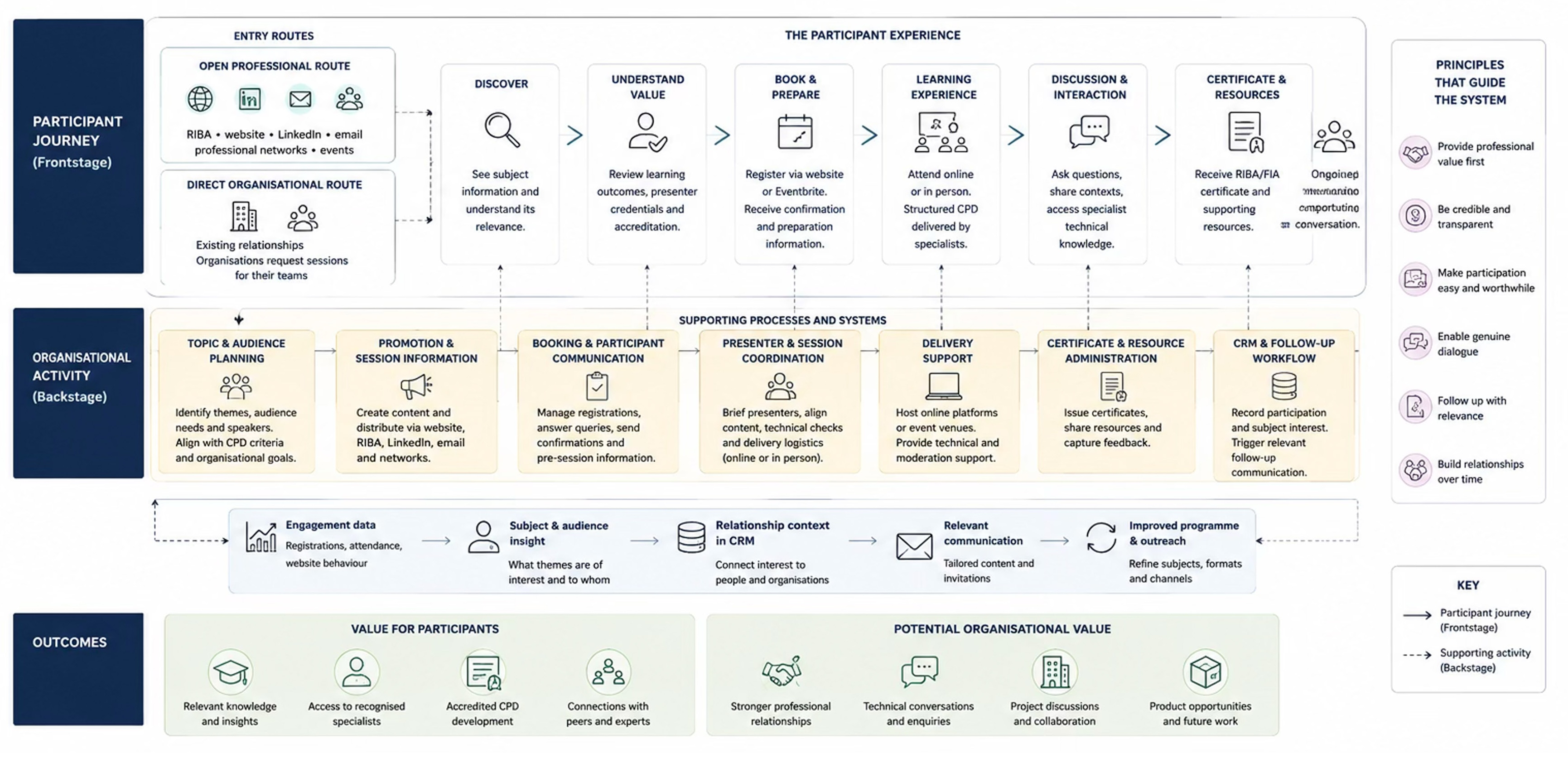
The programme was developed around a wider engagement journey rather than a standalone presentation. The aim was to give relevant professionals a worthwhile reason to engage with Llumarlite’s expertise, create opportunities for useful discussion, and support those relationships beyond the learning session where there was mutual relevance.
This meant considering the complete journey from the outset: how people would discover relevant subjects, understand their value, register and prepare, participate online or in person, interact with specialists, receive supporting material and continue the conversation afterwards. Promotion, booking, participant communication, delivery and follow-up were therefore developed as connected parts of the programme.
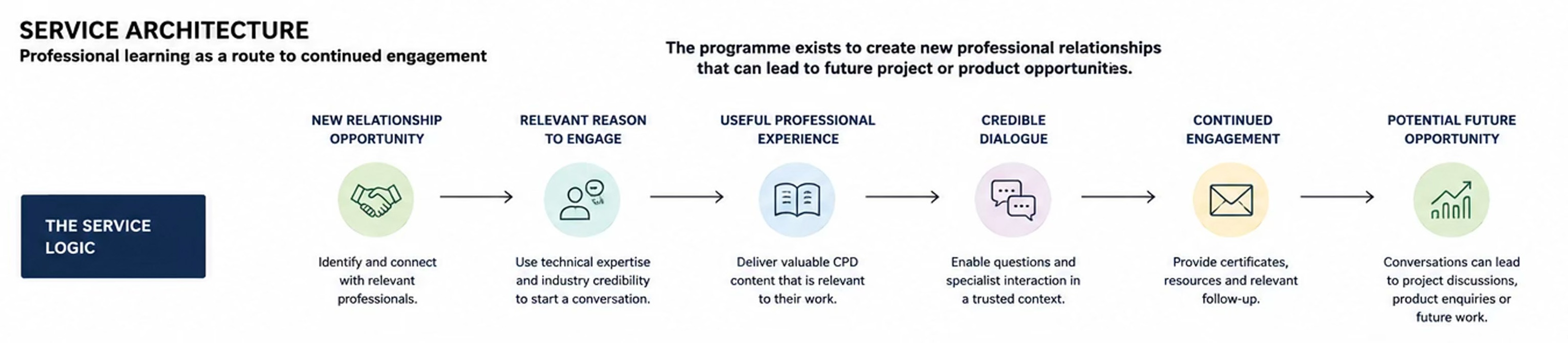
The programme used accredited learning to create a relevant reason to engage, open dialogue with specialists, and build relationships beyond the session.
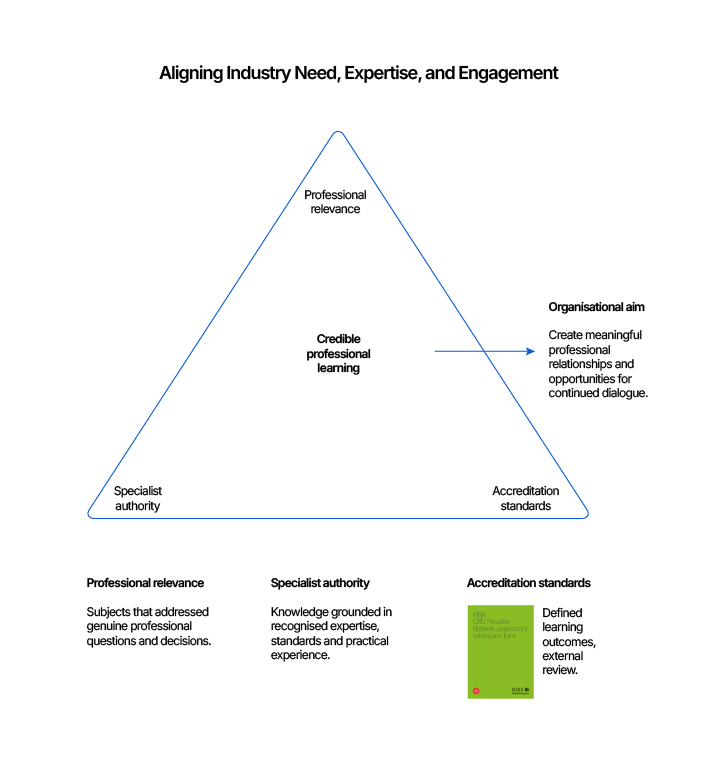
Once RIBA had been selected, the commercial purpose behind the programme had to remain secondary to the learning experience. RIBA had clear criteria for CPD providers: material was independently assessed to ensure it was educational and evaluated for accuracy, relevance and balance before approval.
Approved CPDs were mapped to RIBA’s Core Curriculum, an important aspect for Llumarlite because Chartered Members were required to complete 35 hours of CPD each year, with at least 20 hours covering the ten mandatory Core Curriculum topics.
The external accreditation process became an important part of developing the material. Draft content was reviewed by RIBA and challenged where it did not meet their educational or non-promotional requirements.
Removing or reframing material that some stakeholders wanted to retain occasionally created tension, but protecting the credibility of the learning took precedence over the immediate sales message.
Credibility also came from the people delivering it. The technical specialists were already recognised within their fields through their involvement with industry bodies, technical standards and regulatory development. Their knowledge allowed the sessions to draw on current standards, practical application and professional experience rather than relying on company claims.
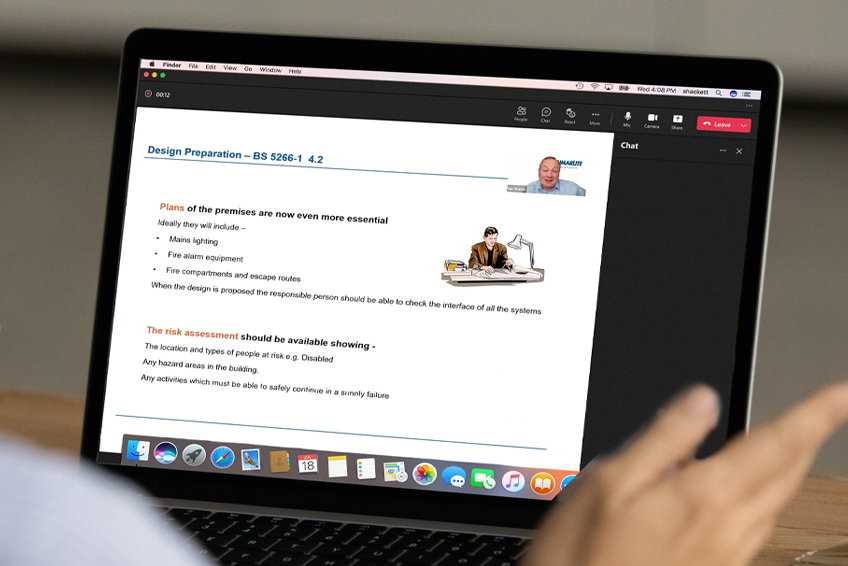
For online RIBA delivery, the learning was supported by short knowledge assessments drawn from banks of subject-specific questions, providing a further check that participants had understood the material rather than simply attended a presentation.
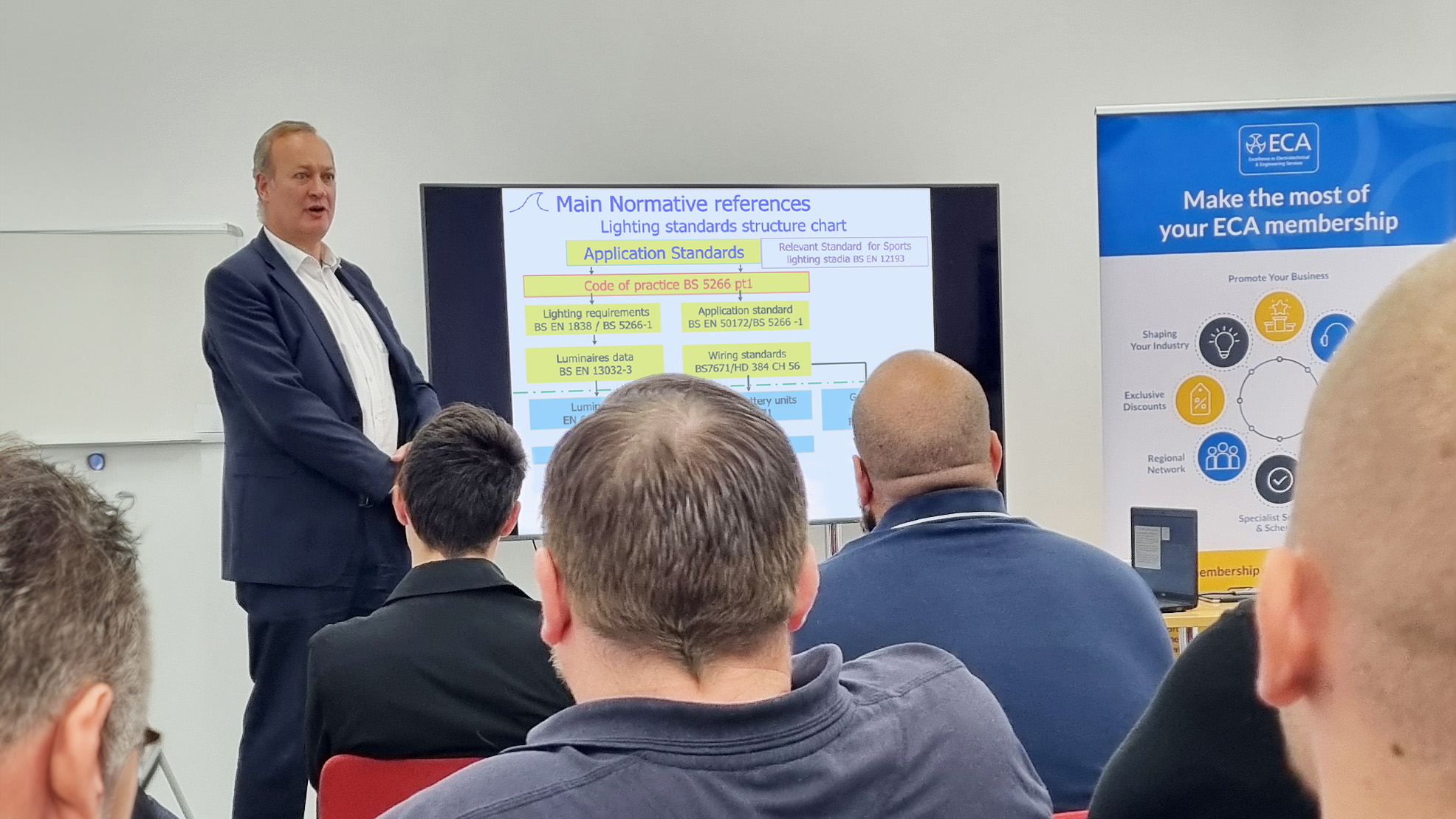
It was important for the technical specialists to retain authorship and authority over the learning material throughout the project. Working alongside them, my role was to question assumptions, clarify language, structure information and develop visual explanations, making sometimes complex subject matter more accessible without weakening its technical substance.
The level of design intervention varied according to the learning context. The RIBA CPDs were being developed as new, standalone learning experiences for a broader professional audience. Working within the accreditation requirements provided a common structure around audience, learning aims and outcomes, progression through the subject and practical application. This created greater consistency between the RIBA sessions while still allowing each specialist subject to determine the content.
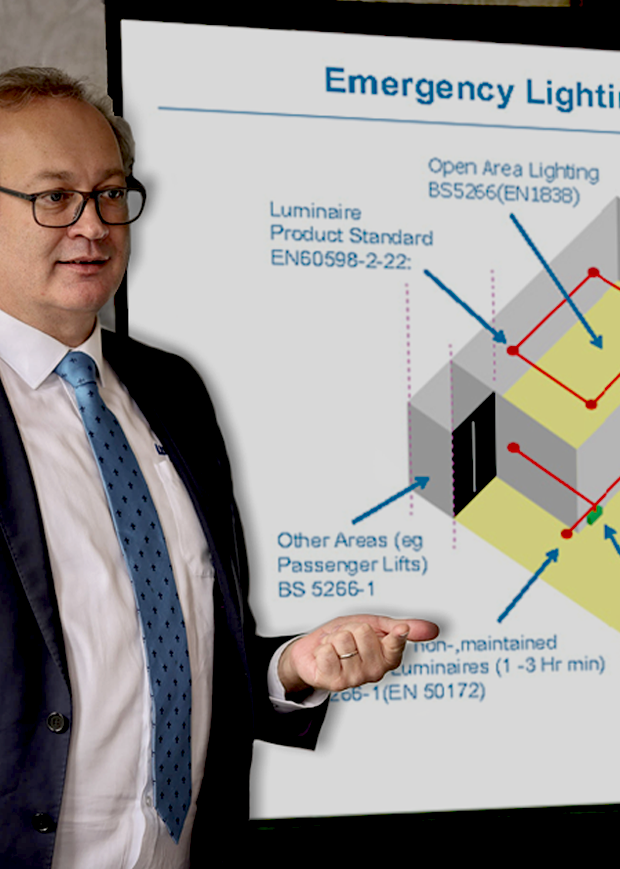
The FIA emergency-lighting material required a different approach. It had developed from an established, more detailed technical course and
was already familiar to the specialist delivering it. When adapting the material for shorter online and in-person sessions, I focused on where clarification, hierarchy or visual explanation would add value rather than imposing the same structure or visual treatment used for the RIBA CPDs.
Familiar images, examples and sequences often acted as prompts for the presenter, supporting explanations built through years of experience. Changes were therefore made collaboratively, considering not only what might make a slide visually cleaner, but what would help participants understand the subject while allowing the presenter to remain confident and fluent in its delivery.
Although the presentations shared a visual language connected to Llumarlite’s wider identity, the aim was not to make every presentation look or behave the same. Coherence was introduced where it improved the learning experience, but not at the expense of how the specialists themselves worked with and delivered their material.
Refining existing specialist FIA material
Technical colleagues retained authority over the content and how it was delivered.
Hierarchy, grouping and visual structure were refined where they could improve understanding.
Newer learning material connected standards and principles to professional decisions and real cases.
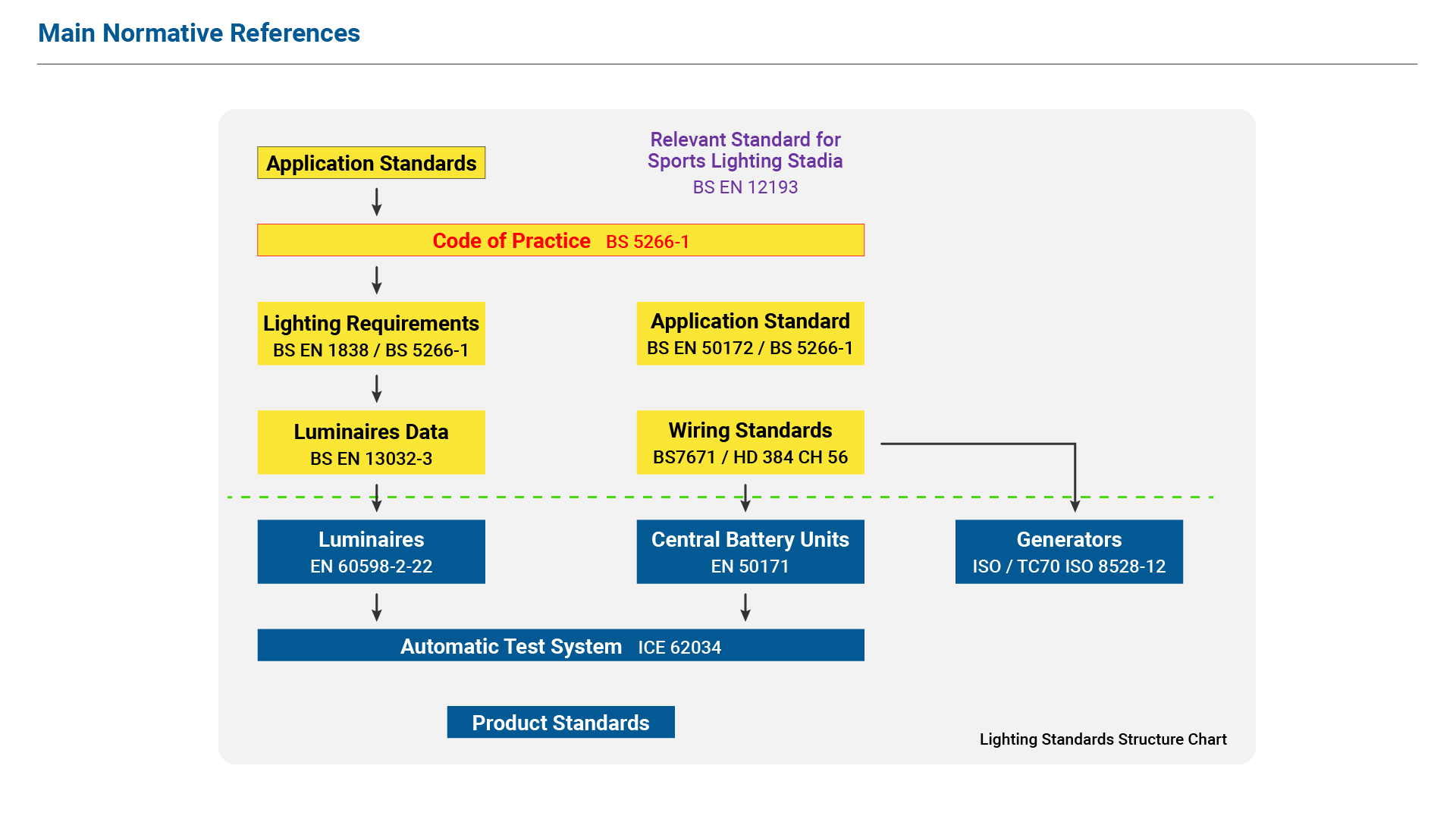


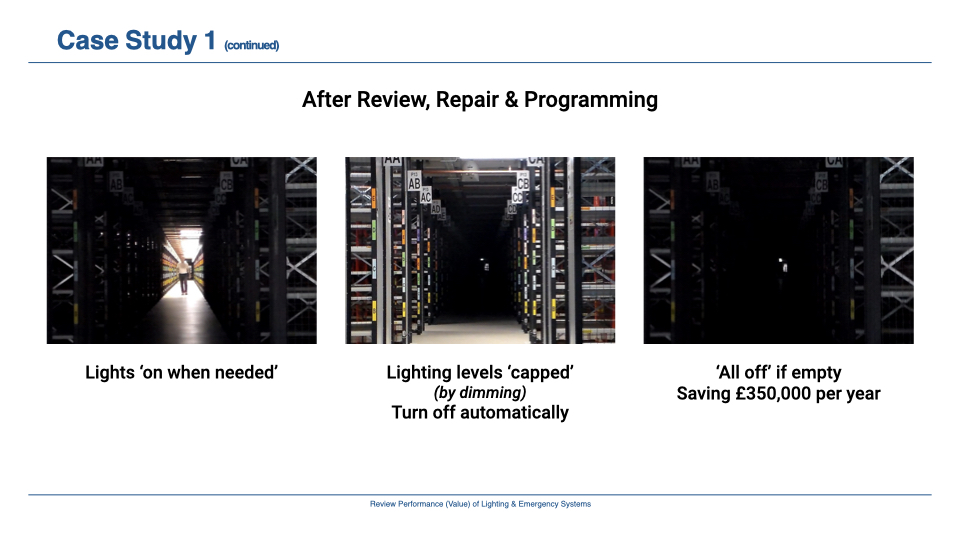
Ongoing refinement was built into the service architecture from the outset, with live experience, participation data and digital engagement feeding back into later sessions and supporting touchpoints.
Dry runs helped identify potential issues with pacing, explanation and presentation style, but repeated online and in-person sessions showed where those issues actually affected the experience. Seeing audiences respond in real time revealed where technical detail became difficult to follow, audience attention began to drift, or particular subjects prompted stronger discussion. This gave us a clearer basis for adjusting pacing, sequencing, visual explanation and facilitation.
Digital and participation data helped refine the wider programme, with page views, campaign clicks, registrations, attendance and enquiries showing which subjects were attracting interest and where additional promotion was needed. Stronger-performing sessions were offered more frequently, while weaker ones could be supported through additional outreach; we also tested different days and times, recognising that the conditions that encouraged people to register were not always the same as those that resulted in attendance.
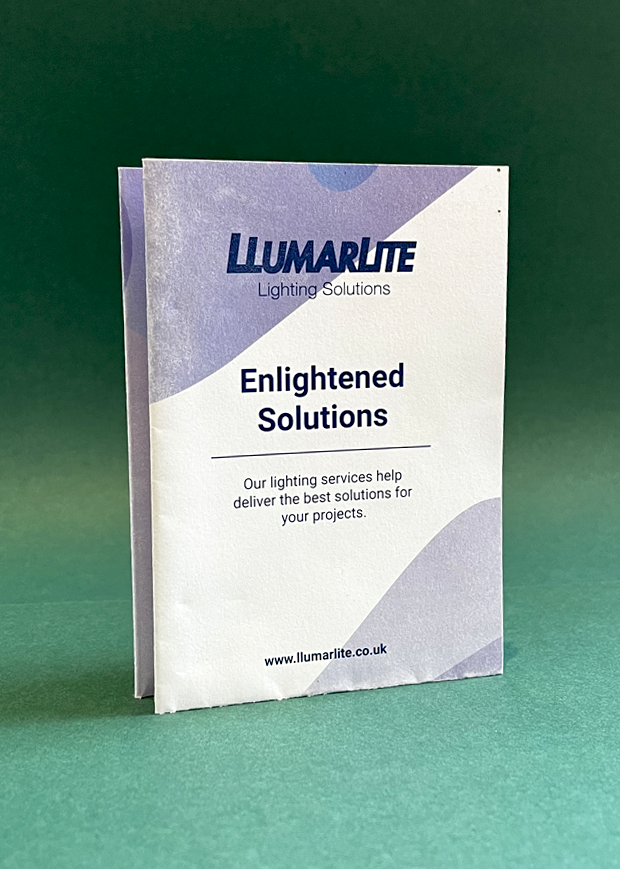
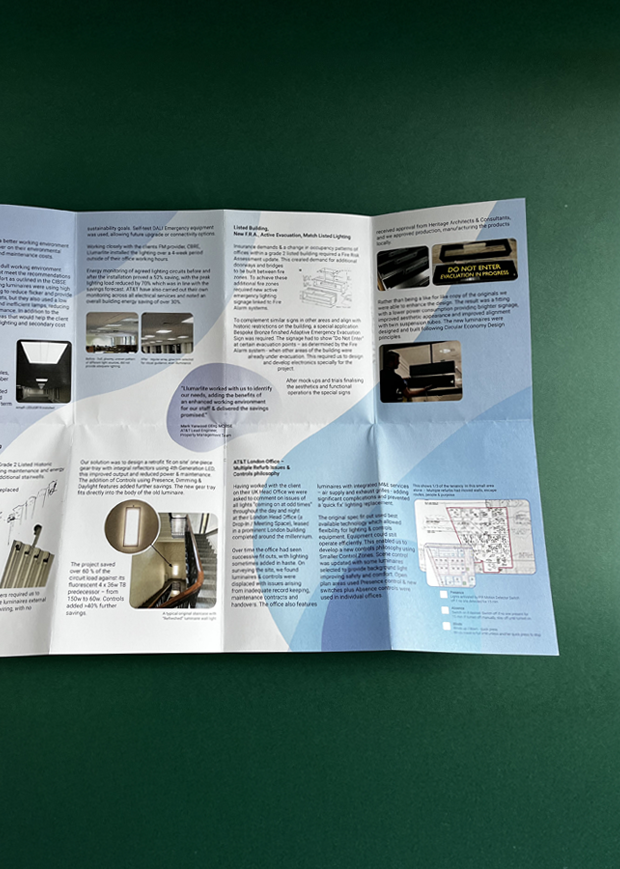
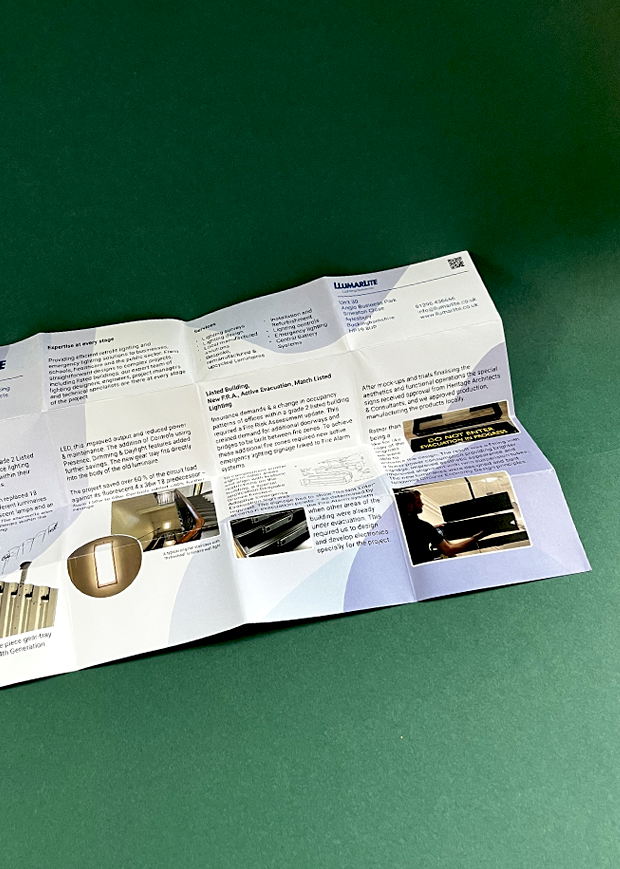
Other touchpoints evolved alongside the sessions, including an early fold-out participant handout that was developed into a smaller, business-card-sized format which was easier to carry, retain and refer back to at events. Participant communications and follow-up continued to develop as the programme matured and patterns of engagement became clearer.
The presenters requested that the fold-out handout was reduced to a smaller format making it easier to transport to events and for participants to retain and refer back to after events. The Revised business card fold-out design was able to retain all the important information and most of the project examples shown in the original.

technical colleagues retained authority over the content and how it was delivered.
hierarchy, grouping and visual structure were refined where they could improve understanding.
Newer learning material connected standards and principles to professional decisions and real cases.
Over four years, the professional-learning programme became a regular part of how Llumarlite engaged with built-environment professionals. Across 58 company-delivered sessions, records show 745 attendances for which CPD certificates were issued: 627 through FIA-accredited learning and 118 through the two years of RIBA-accredited CPDs.
The programme extended Llumarlite’s reach into professional audiences that had previously been difficult to access through conventional relationship-building. The Introduction to Emergency Lighting CPD alone accounted for 598 recorded attendances across its different sessions, drawing participants from engineering consultancies, property and facilities teams, public-sector organisations and specialist contractors.
Reach was not limited to open sessions, with organisations also requesting learning directly for their teams and creating opportunities for more focused discussion around their own buildings, responsibilities and technical challenges. TfL and engineering consultancy Cundall were among the organisations that hosted larger sessions, with further sessions and different CPD subjects requested over time, providing evidence that the programme was supporting continued professional relationships rather than only one-off engagement.
The result was a repeatable engagement model that connected accredited learning, recognised technical expertise and relevant follow-up, giving Llumarlite a credible way to develop professional relationships while providing genuine value to participants.
Sustained professional reach
58 company-delivered sessions generated 745 recorded attendances over four years.
Accredited learning at scale
627 recorded attendances through FIA-accredited learning and over 400 through RIBA-accredited CPDs.
Continued professional relationships
Direct team sessions, repeat bookings and requests for different CPD subjects included organisations such as TfL and Cundall.
A repeatable engagement model
Accredited learning, specialist dialogue, supporting touchpoints and relevant follow-up worked together across open and organisation-specific sessions.
Establishing the service architecture early made the relationships between participant needs, technical expertise and supporting organisational activity explicit. It clarified where responsibility should sit, allowing specialists to retain ownership of technical content while I concentrated on how the wider experience worked across promotion, booking, communication, delivery and follow-up. The CPDs were the principal participant-facing touchpoint, but their effectiveness depended on the system around them.
Working with the presenters reinforced that improvement could not always be imposed at the point a problem was identified. Familiarity with material, individual confidence and established ways of working shaped how changes could be introduced. In some cases, allowing a session to run and reviewing the evidence together created a stronger basis for change than trying to resolve everything beforehand.
When COVID forced the programme fully online, the underlying architecture allowed the core service to continue through an existing online route, but exposed the value of interactions that were harder to reproduce digitally. The learning remained effective, but the move online diminished the informal discussion, networking and post-session conversations that were an important part of both the service and Llumarlite’s relationship-building. It demonstrated that service resilience depended not only on maintaining individual touchpoints, but on the relationships and value exchanges between them.